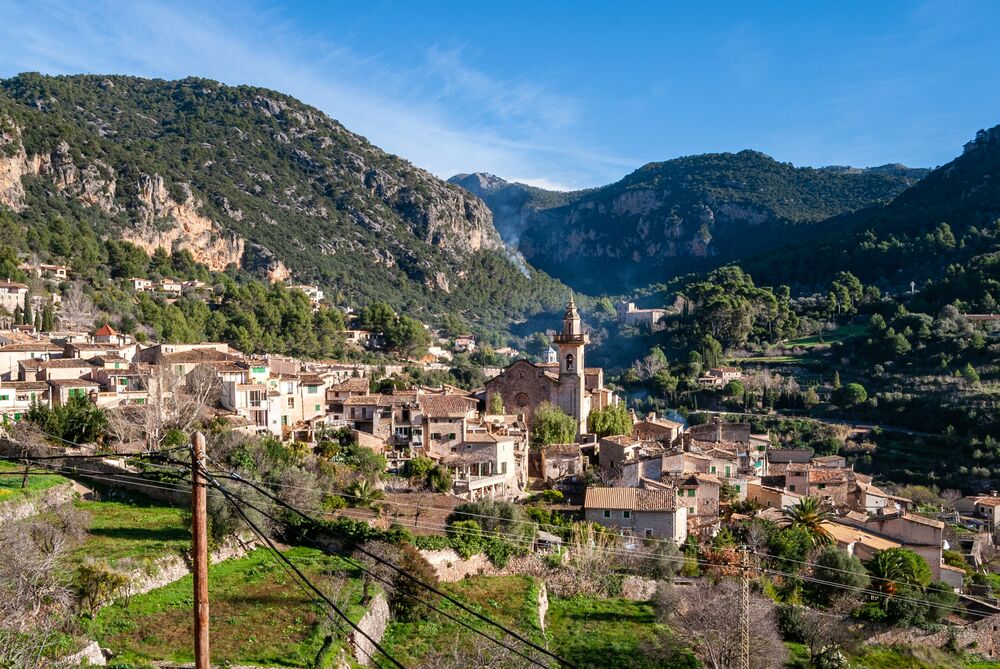
There are villages in Europe that wear their history loosely. Valldemossa is not one of them. Tucked into the foothills of the Serra de Tramuntana, half an hour north of Palma, the village carries its past the way a careful host carries a tray — with attention, with quiet pride, and with no inclination to set it down. Carthusian monks lived here for over five centuries. Frédéric Chopin and George Sand spent a difficult, formative winter inside the same monastery walls in 1838. Mallorca’s only canonised saint, Santa Catalina Tomàs, was born in one of its houses. Today, the village continues to draw the kind of visitor for whom a holiday is also a quiet inheritance.
A Sense of Place
The drive into Valldemossa from Palma takes around thirty minutes — long enough for the city to fade, short enough that the village rewards a half-day visit even on a busy trip. The road climbs gently into the Tramuntana, opening toward terraced olive groves and the kind of light that has drawn painters to this stretch of coast for more than a century.
What greets you in the village itself is restrained — almost monastically so. Honey-coloured stone houses lean against each other along cobbled lanes. Potted plants and trailing vines soften the doorways. Bell towers signal time the way they have for centuries. The village protects its quiet with surprising effectiveness: even at peak summer, when the day-trip coaches arrive from Palma, by late afternoon Valldemossa returns to a near-meditative pace.
The UNESCO designation extended over the wider Serra de Tramuntana has helped preserve this character. Heavy development is restricted, and what visitors find today is not a recreation of an old village but the village itself, lightly maintained.
The Winter With Chopin
The most famous chapter in Valldemossa’s history is also its most complicated. In November 1838, the Polish composer Frédéric Chopin arrived in the village with the French novelist George Sand and her two children. Chopin was already in the early stages of the tuberculosis that would shorten his life, and the couple had hoped that a Mediterranean winter would aid his recovery.
It did not. The weather that season was unusually wet and cold. The locals — wary of Chopin’s illness — kept their distance, and the household struggled to find adequate food and warmth in their rented cells at the Real Cartuja, the former Carthusian monastery. Sand later wrote an account of the experience, A Winter in Majorca, which depicted the islanders in terms locals have not entirely forgiven nearly two centuries later. Many shopfront signs in the village today politely correct the record.
And yet — through one of the curious bargains of art — that difficult winter produced extraordinary work. It was in those cold monastery rooms that Chopin completed his Preludes, Op. 28, among his most enduring contributions to the piano repertoire. His Pleyel piano arrived from Paris in late January after a customs delay that nearly destroyed it, and he composed on it until they departed in February 1839. The instrument remains today in the monastery cells, alongside Chopin manuscripts and Sand’s own writing desk — small rooms whose silence still feels, somehow, productive.
The Real Cartuja de Valldemossa
The monastery itself is the village’s defining building. Founded as a Carthusian charterhouse in 1399, the Real Cartuja was inhabited by the order until 1835, when Spanish law dissolved many religious communities and the cells were sold to private buyers. It was these private owners who, only three years later, rented rooms to Chopin and Sand.
Today the monastery operates as a museum complex. Visitors walk through the cells, the apothecary (still preserved with its 17th- and 18th-century ceramic jars), the church, the cloisters, and the rooms commemorating the Chopin–Sand winter. Recitals are still held in the monastery’s small concert hall during the warmer months, and the experience of listening to Chopin played live in the building where he composed is one of the genuinely affecting cultural moments available on the island.
The wider site also houses the Costa Nord Cultural Centre, an institution co-founded by the actor Michael Douglas — a long-time resident of Mallorca — to promote and preserve the cultural heritage of the Tramuntana. The centre operates educational programmes and runs occasional exhibitions worth checking before your visit.
The Village Itself
Walking Valldemossa rewards a slow pace. The principal sights cluster within easy distance: the monastery sits at the upper edge of the village; the parish church of Sant Bartomeu sits below it, with views that open over the rooftops; and the warren of lanes between them rewards aimless wandering more than any planned itinerary.
The church of Sant Bartomeu is worth a quiet visit. Built in the 13th century and rebuilt across subsequent eras, it holds the relics of Santa Catalina Tomàs — the only Mallorcan saint, and a figure of profound devotion across the island. Catalina was born in Valldemossa in 1531 and took the veil in Palma as an Augustinian nun. After her canonisation in 1930, her cult became a quiet, persistent thread through Mallorcan religious life.
The clearest signs of her presence here are easy to miss at first: above many of the village’s doorways, you’ll find small ceramic tiles depicting the saint, placed there by families to invite her blessing on their home. Once you start looking for them, you see them everywhere.
The annual festival of La Beata, held in late July, is the village’s emotional centre. Costumed processions wind through the streets in honour of Santa Catalina; the village transforms with flowers and lights; and the feeling — quite unlike the more touristic festivals elsewhere on the island — is one of a community celebrating itself.
A Word About Cocas de Patata
Valldemossa is the birthplace of one of Mallorca’s most distinctive baked goods: cocas de patata. These small, slightly sweet potato-based pastries — dusted with powdered sugar, often eaten with morning coffee — have spread across the island but remain at their finest here.
The village bakery Ca’n Molinas is the institution most associated with the original recipe and continues to draw a queue each morning. Pair a coca de patata with a glass of cold almond milk — another Mallorcan tradition — and you have a breakfast ritual that has changed remarkably little in the past century.
The Chopin Festival
The cultural anchor of Valldemossa’s summer is the Festival Chopin, held annually since 1931 in the gardens and concert hall of the Real Cartuja. Pianists of international standing come to perform the composer’s work — and works by other Romantic-era composers — in the very building where some of those pieces were written. The festival typically runs across August, with concerts in the late afternoon and evening.
For travellers planning a trip that incorporates Valldemossa, the festival calendar is worth checking early. Tickets for the most anticipated performances move quickly, and the experience of attending a Chopin recital in the Real Cartuja is one of the most memorable cultural offerings on the island.
Where to Stay
Hotel Valldemossa is the village’s most considered address — a five-star property set in a restored estate at the edge of the village, with rooms looking out over the monastery and the valley beyond. The hotel’s wellness programme, anchored by its Valldemossa Longevity initiative, draws guests for week-long retreats; the kitchen is run with seriousness; and the property’s understated luxury matches the village’s tone exactly.
Es Petit Hotel de Valldemossa offers a different proposition — a small property in the heart of the village itself, with the kind of intimate scale that suits a romantic or solo stay. Eight rooms, traditional features, and warm, family-run hospitality.
Mirabó de Valldemossa, just outside the village, is set in a traditional Mallorcan finca with substantial gardens and a generous pool. For travellers who want Valldemossa as a base but prefer a more rural rhythm, Mirabó is the answer.
Many visitors also choose to base themselves in Deià or Palma and visit Valldemossa as a day or half-day trip — a perfectly reasonable approach given the village’s compact size.
Where to Eat
Es Port is the village’s most consistent table — Mallorcan classics done with care, served on a terrace that catches the afternoon light at exactly the right angle. Local lamb, fresh fish, a considered wine list. Booking is essential in summer.
Restaurant Valldemossa at the hotel of the same name offers a more elevated experience, with a tasting menu drawn from the surrounding land and the kitchen garden. For travellers staying elsewhere who want a serious meal in Valldemossa, this is the room to book.
Forn Bar sits in the centre of the village and serves classic island cuisine in a warm, family-run setting. Reliable, generous, and very much of the village.
Café Bar S’Hostal is the right pause mid-walk — coffee, a coca de patata, and a view down over the rooftops.
Where Valldemossa Sits in a Wider Trip
For travellers building a Tramuntana-focused stay, Valldemossa pairs naturally with Deià. The two villages sit twenty minutes apart along the coast road, and a day spent walking both — perhaps with lunch in Deià and an afternoon recital in Valldemossa — captures something essential about the Tramuntana that neither village quite delivers alone.
Just outside Valldemossa, on the road north, sits Son Marroig — the former estate of Archduke Ludwig Salvator, now a quietly compelling museum, with one of the most photographed cliffside terraces on the island. Miramar, the philosopher Ramón Llull’s former missionary school, sits along the same road.
Further north, Sóller and Port de Sóller are within easy day-trip range — the historic wooden train from Palma to Sóller is one of the small pleasures of Mallorca, and the journey passes within sight of the Valldemossa hills.
Living in Valldemossa
For those drawn to the village beyond the trip, Valldemossa has long attracted a small but committed community of permanent residents — creative professionals, retirees from northern Europe, and a quiet cohort of Americans drawn here through their own version of Chopin’s winter retreat. Michael Douglas remains the most visible of these, but the population is genuinely diverse.
Property here, as throughout the Tramuntana, is governed by UNESCO heritage protections that meaningfully restrict new development. The result is a market characterised by traditional stone properties, carefully restored, changing hands quietly. Prices are substantial; turnover is slow.
The village’s winter character is markedly different from its summer. The mountains hold the cold, occasional snow falls in the higher reaches of the Tramuntana, and Valldemossa returns to something close to the village Chopin found in 1838. For those who can adapt to it, the off-season is the village at its most authentic.
Valldemossa rewards the kind of traveller for whom a destination is also a kind of inheritance — a place not simply visited but lived inside, even briefly. Two centuries after Chopin’s difficult winter, the music he composed in these rooms continues to be played here in the afternoon light. That continuity — between art and place, between past and present — is the village’s quietest gift.